Press release
RSPN organized 18th Annual Community Convention on ‘Localising Development Through Community Partnerships
DTC Press Release Distribution Network · 17 November 2026
Islamabad, November 17, 2026:
The Rural Support Programmes Network (RSPN) organized its 18th Annual Community Convention in Islamabad on the theme ‘Localising Development Through Community Partnerships’. The convention was attended by the community leaders from across Pakistan.
Addressing the convention as the chief guest, Bilal Azhar Kayani, Minister of State for Finance and Revenue, Government of Pakistan, applauded the community presenters and committed to working with RSPN to bring their experiences into policymaking.
He further said that, this convention lets us hear the realities on the ground directly from the people. The stories shared by the community people are truly inspiring. Rural communities are remarkably organised and aware, and their spirit is about the collective good, not individual interest. I will sit down with RSPN’s leadership to understand what more we can do together, and to bring these lessons into policymaking.
Earlier, opening the convention, Shandana Khan, chief executive officer of RSPN, thanked participants for travelling from every corner of the country. She called on government to work directly with community organisations and institutions, citing the RISE programme in Balochistan and the Sindh People’s Housing for Flood Affectees (SPHF) programme as examples.
Since 1982, the Rural Support Programmes have been guided by one conviction: development must be of the people, by the people and for the people. When government and community institutions work together, public investment reaches those who need it most.
Masood ul Mulk, vice chair of RSPN, told participants, today is your day to share, and our day to learn. He remarked that the organisations best placed to unlock the potential of communities are those able to listen, respond, adapt and be accountable.
Session I, Building Community Resilience, heard from community leaders in Badin, Upper Chitral, Jacobabad, Washuk, Tharparkar and Swat. Women in Badin described growing their enterprises through interest-free credit; a village organisation in upper Chitral brought electricity to 350 households; a Local Support Organisation in Jacobabad rebuilt 200 flood-damaged homes; and an LSO in Washuk enrolled 900 out-of-school children, 552 of them girls.
A panel with the EU Delegation, SPHF, the British High Commission and the Balochistan Rural Support Programme (BRSP), moderated by Khaleel Ahmed Tetlay, called for integrated, demand-driven development with communities at the centre. Panellists highlighted community-led reconstruction of one million flood-resilient homes in Sindh, holistic education recovery to bring girls back to school after floods, and grants and vocational training for young people under the RISE programme in Balochistan.
Concluding the session, guest of Honour Jeroen Willems, Head of Cooperation at the Delegation of the European Union to Pakistan, set out partnership, preparedness, inclusion and sustainable investment as the lessons for the future. He said: Communities must be partners in development. Resilience is not just recovery; it is also about being prepared to respond.
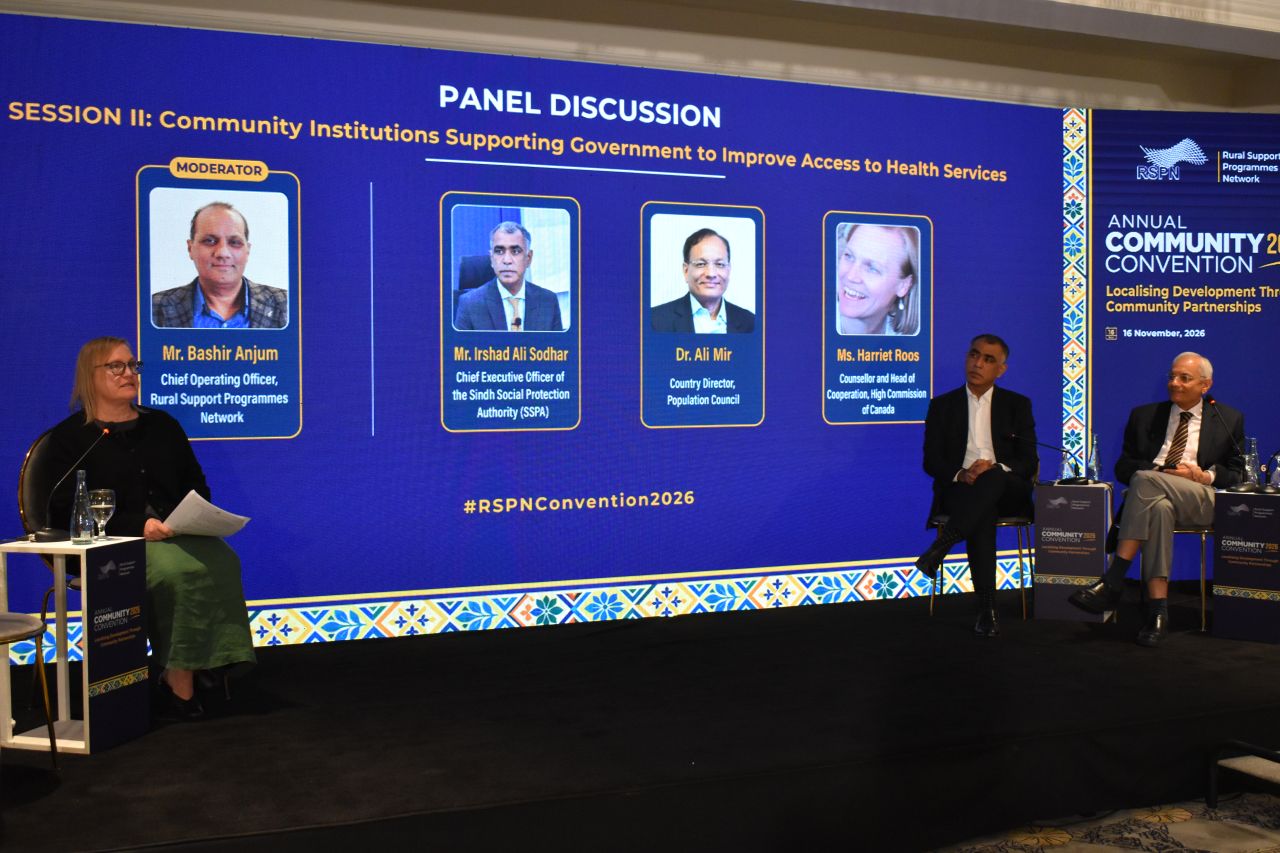
Session II, Community Institutions Supporting Government to Improve Access to Health Services, featured community health leaders from Tharparkar, Qambar Shahdadkot, Gilgit and Haripur, who link families with maternal and child health, family planning and TB care services. On the panel, moderated by Bashir Anjum, chief operating officer of RSPN, the Sindh Social Protection Authority reported that registration of pregnant and breastfeeding mothers doubled within a year once it partnered with community organisations and RSPs. The Population Council and the High Commission of Canada underlined the role of community health workers and women’s decision-making in improving health outcomes.
Guest of honour Samar Haroon Bilour, advisor to the Governor on Information and Public Relations, Government of Khyber Pakhtunkhwa, praised RSPN’s Husband School model, noting that family health decisions are now a dialogue, not a monologud, she remarked.
We share common goals. I want to understand how we can build on the work of the RSPs in Khyber Pakhtunkhwa. Your work is more important than ours: communities may look at public figures with scepticism, but they trust you.
Session III, Digital Revolution: From Digital Learners to Economic Leaders, featured young people and women entrepreneurs from Chitral, Baltistan, Nowshera, Rawalpindi and Islamabad who have turned digital skills into livelihoods. A young woman in Chitral now earns around Rs75,000 a month selling on Amazon’s US marketplace; an IT hub in Baltistan is creating jobs for local youth; and women in Nowshera and Rawalpindi are running tailoring and online businesses, training other girls and supporting their families.
A panel with UN Women Pakistan, Circle Women Foundation, and social entrepreneur Saleem Ranjha discussed how skills, enterprise support and financial inclusion can widen economic opportunity for women.
The chief executive officers of the RSPs reflected on the way forward, and Shandana Khan closed the convention with a vote of thanks to all participants and partners.
The people from upper Chitral in the north to Washuk in Balochistan share their experiences directly with senior representatives of the Government of Pakistan, the Government of Khyber Pakhtunkhwa, the European Union, the British High Commission, the High Commission of Canada, UN agencies, civil society, the private sector and academia.